
Virtual mailbox providers serve thousands of customers across the US. Every new client needs a USPS Form 1583. That form requires notarization. No exception. Without it, the USPS will not authorize mail forwarding. The problem? Traditional notarization slows down customer onboarding.
A proper online notary service solves these issues. It speeds up Form 1583 completion. It builds a verifiable audit trail. It also verifies signer identity in real time. This article compares the top four remote online notarization platforms. The focus is on USPS compliance. The goal is to help virtual mailbox providers choose the right partner.
Virtual mailbox providers operate in a regulated space. The USPS demands strict adherence to Form 1583 rules. A remote online notary platform must meet those rules. Otherwise, the provider risks losing its mailing authorization. That is a serious business threat.
Why USPS Form 1583 Requires More Than Basic Notarization
Form 1583 is not a simple document. It carries legal weight. The USPS uses it to prevent mail fraud and identity theft. Three specific requirements make it different from other notarized forms.
Mandatory identity verification (KYC)
The USPS demands that every Form 1583 signer prove who they are. A basic notary stamp is not enough. The notary must check a government-issued ID. For remote sessions, that means real-time credential analysis. The platform must confirm the ID is genuine. It must match the person on camera.
Tamper-evident seal on completed forms
Once notarized, Form 1583 cannot be altered. Any change voids the document. A tamper-evident seal protects against post-signing edits. The USPS checks for this seal during compliance reviews. Without it, the form gets rejected.
Audit trail for USPS compliance reviews
The USPS can audit any virtual mailbox provider at any time. The provider must produce every signed Form 1583. More importantly, the provider must prove the notarization happened correctly. That means a full audit trail. Session video. Identity check results. Timestamps. A proper online notary service generates all of this automatically.
Several platforms offer remote online notarization. Only a few handle USPS Form 1583 correctly. Here are the top four.
1. OneNotary (Best for USPS Compliance)
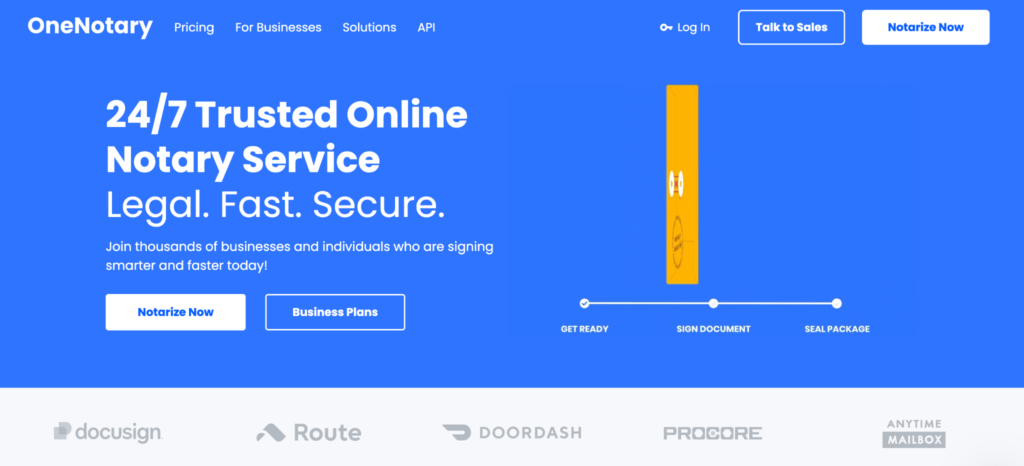
OneNotary, an online notary service firm, builds its platform specifically for regulated industries. Virtual mailbox providers get everything needed for USPS compliance. The platform does not treat Form 1583 as an afterthought. Every feature exists to meet USPS requirements head on.
How OneNotary handles Form 1583
- Credential analysis built in – The system checks government IDs against 100+ data points. Holograms, fonts, and barcodes get verified instantly.
- Live notary sessions with KBA – Customers answer dynamic questions based on credit header data. This stops identity fraud cold.
- Tamper-evident seal on every PDF – Once notarized, the form locks permanently. Any edit attempt breaks the seal.
- Full audit trail storage – Session video, IP logs, ID check results, and timestamps live in one dashboard. USPS auditors get what they need in seconds.
Why virtual mailbox providers choose OneNotary
Virtual mailbox providers using OneNotary get a compliant remote online notarization platform with identity verification and full audit trails — purpose-built for digital mailbox compliance. The API connects directly to customer onboarding flows. New users complete Form 1583 without leaving the provider’s website. The white-label option keeps branding consistent. Bulk processing handles hundreds of forms daily.
2. BlueNotary
BlueNotary markets itself as an affordable remote online notarization option. Many small businesses use it for basic documents. For Form 1583, the platform works but comes with limits. The lower price point attracts virtual mailbox providers with low volume. However, the missing features create risk as the business grows.
What does BlueNotary delivers
- Affordable per-session pricing – Usually cheaper than enterprise competitors.
- 24/7 notary availability – Customers can complete forms at any hour.
- Basic credential analysis – Checks ID presence but lacks depth.
BlueNotary’s current limitations include shallow audit trails, meaning session logs may lack the full detail required by a USPS examiner; the lack of a white-label option, which forces customers to see BlueNotary’s branding instead of the provider’s; and a limited API that necessitates custom workarounds for automated processing, such as for Form 1583.
The real trade-off: A provider saves money upfront but spends more time on manual compliance tracking. One missing audit trail can trigger a USPS review that shuts down mail forwarding for days.
3. NotaryLive
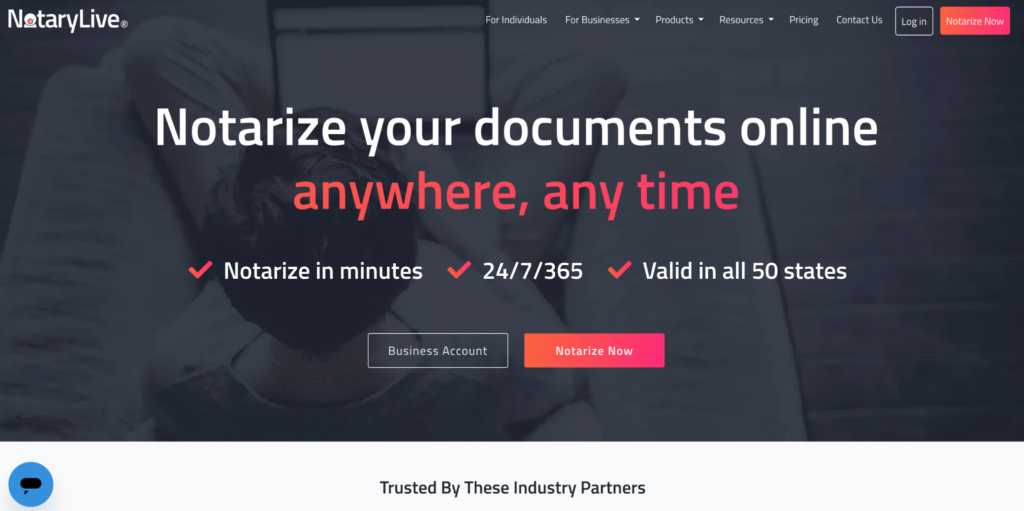
NotaryLive focuses on connecting customers to live notaries quickly. The user interface is clean. Connection times are fast. For a one-off Form 1583, the experience feels smooth. But virtual mailbox providers need more than a smooth customer experience. They need automation, tracking, and audit readiness.
What NotaryLive lacks for virtual mailbox providers
The current process is heavily reliant on manual effort, lacking an API for automation, meaning that each Form 1583 requires manual data entry, separate document uploads, session scheduling, and completion tracking in a different system. Furthermore, the platform offers only limited audit trail detail, which may not satisfy the requirements of a serious USPS audit, and the absence of bulk processing capability turns handling even a moderate volume of new customers, such as fifty in a day, into a significant manual burden.
The operational cost: NotaryLive works for a provider with ten new customers per month. At fifty or more per month, manual work eats up staff hours. The lack of API integration becomes a bottleneck.
4. USVirtualNotary
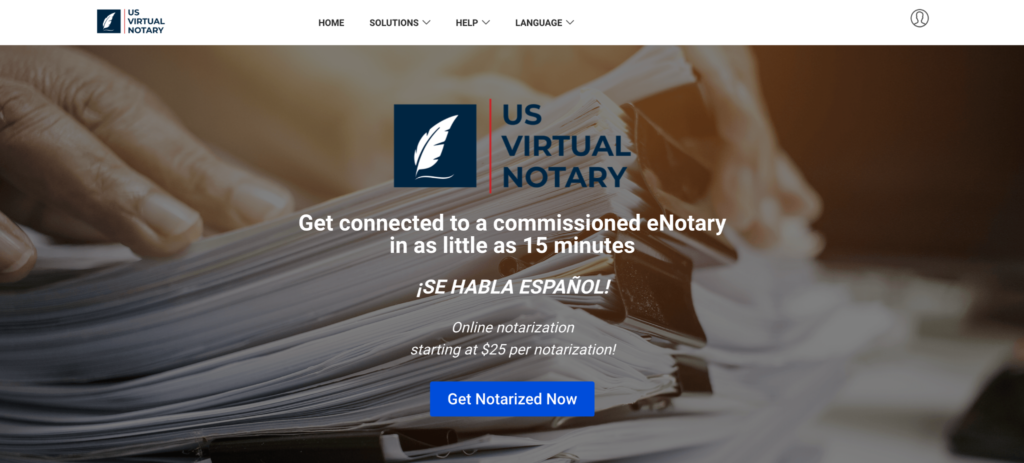
USVirtualNotary specializes in remote notarization only. The platform does one thing and does it legally. Form 1583 notarizations completed through USVirtualNotary meet the letter of the law. But the business model creates a major problem for virtual mailbox providers.
USVirtualNotary Services
- Legally compliant notarizations – No question about validity.
- Notaries understand Form 1583 – They have seen hundreds of these forms.
- Direct customer scheduling – Customers book their own sessions.
Critical flaw for mailbox providers
- No white-label solution. The customer leaves the provider’s website to complete notarization. That breaks the user experience. Conversion rates drop.
- No provider dashboard. Tracking which customers finished notarization requires manual follow-up.
- No API. Automated verification of completion status is impossible.
The customer experience problem: A potential client signs up for a virtual mailbox. They fill out their information. Then they get redirected to USVirtualNotary. The branding changes. The flow feels broken. Many customers abandon the process. The provider loses a sale not because of service quality but because of a disjointed notary handoff.
Your Final Verdict
Virtual mailbox providers face a clear choice. USPS Form 1583 compliance is non-negotiable. Cutting corners on identity verification or audit trails puts the entire business at risk.
OneNotary is the only platform fully aligned with USPS requirements. The combination of KYC verification, tamper-evident seals, and full audit trails creates a complete compliance solution. Add the API and white-label options, and the decision becomes obvious.
For providers handling more than fifty new customers per month, OneNotary pays for itself in reduced manual work alone. For larger operations, the compliance protection is priceless.